In today’s world, the role of satellite communications as a high-tech method of transmitting information and data cannot be overstated. Satellite technologies are widely used for civilian, commercial, and military purposes.
Knowledge of satellite communications systems, their operating principles, and their integration into the overall organization of armed forces is especially important for military communications specialists.
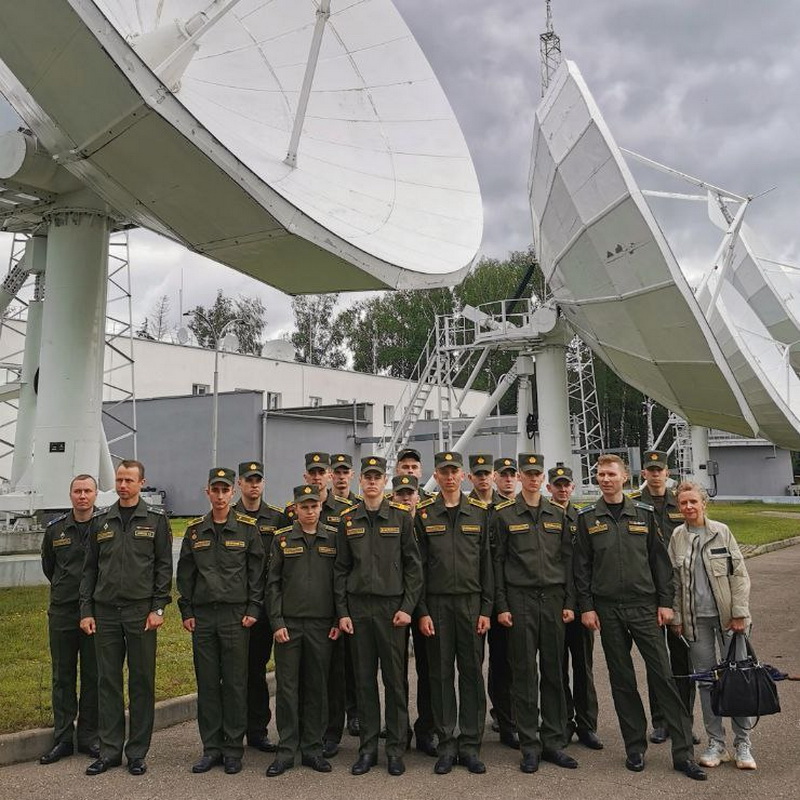
To improve the training of specialists of the Armed Forces of the Republic of Belarus, familiarize them with special-purpose technologies and developments, modern satellite communications systems, operational experience, software, hardware, and information support, a familiarization tour for cadets of the Faculty of Communications and Automated Control Systems of the Military Academy of the Republic of Belarus was held on June 9 at the ground control complex.
The antenna array of the ground control complex became the first place for future communications engineers to become familiar with the elements and operating features of the national satellite communications and broadcasting system.
Oleg Vinyarsky, Head of the Ground Control Complex, provided our guests with a detailed overview of the national satellite communications and broadcasting system. Questions were answered regarding how the repeater in orbit interacts with ground stations located in coverage areas, how the signal is amplified and redirected directly to the receiving area, and what specialized equipment is required to ensure continuous satellite communications in the field.
The cadets were interested in the design features of satellite antennas, the influence of various factors on signal reception quality, and the number of satellites that can be served by a single antenna of a given diameter.
At the Mission Control Center, our guests were introduced to the satellite’s automated control systems and the means for ensuring continuous communication with it. They learned about methods for analyzing and monitoring the satellite’s technical condition, as well as how the control calculations for maintaining a specified orbit are performed.
In the Television, Communications, and Data Transmission Department of the Satellite Ground Application Center, the cadets and team leaders learned about methods for creating TV and radio program packages for satellite broadcasting, organizing satellite data transmission networks, and managing their operation depending on specific conditions.
The meeting, as usual, was held in an open and friendly atmosphere.